ZORA
Table of contents
Description
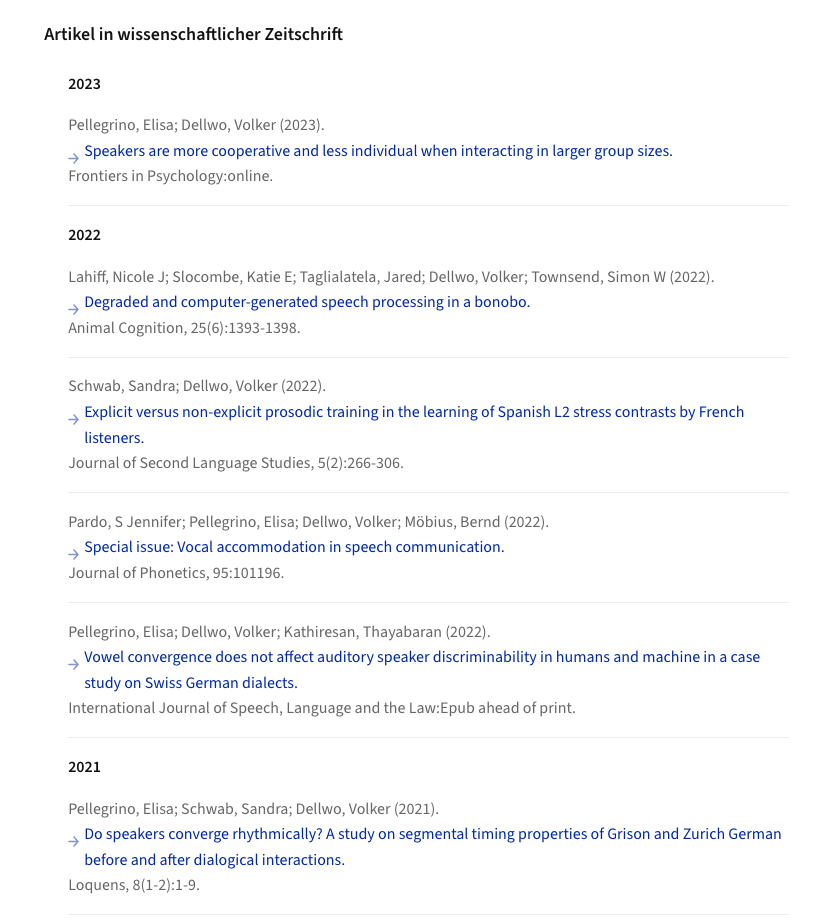
The component "ZORA" allows the inclusion of publications listed in the Zurich Open Repository and Archive (ZORA). These lists are generated dynamically, i.e. they reflect the current content of ZORA.
Creation
- Click on "New Content Component" in the "Content" area.
- Select "ZORA" and confirm with "Next".
The following window is displayed:
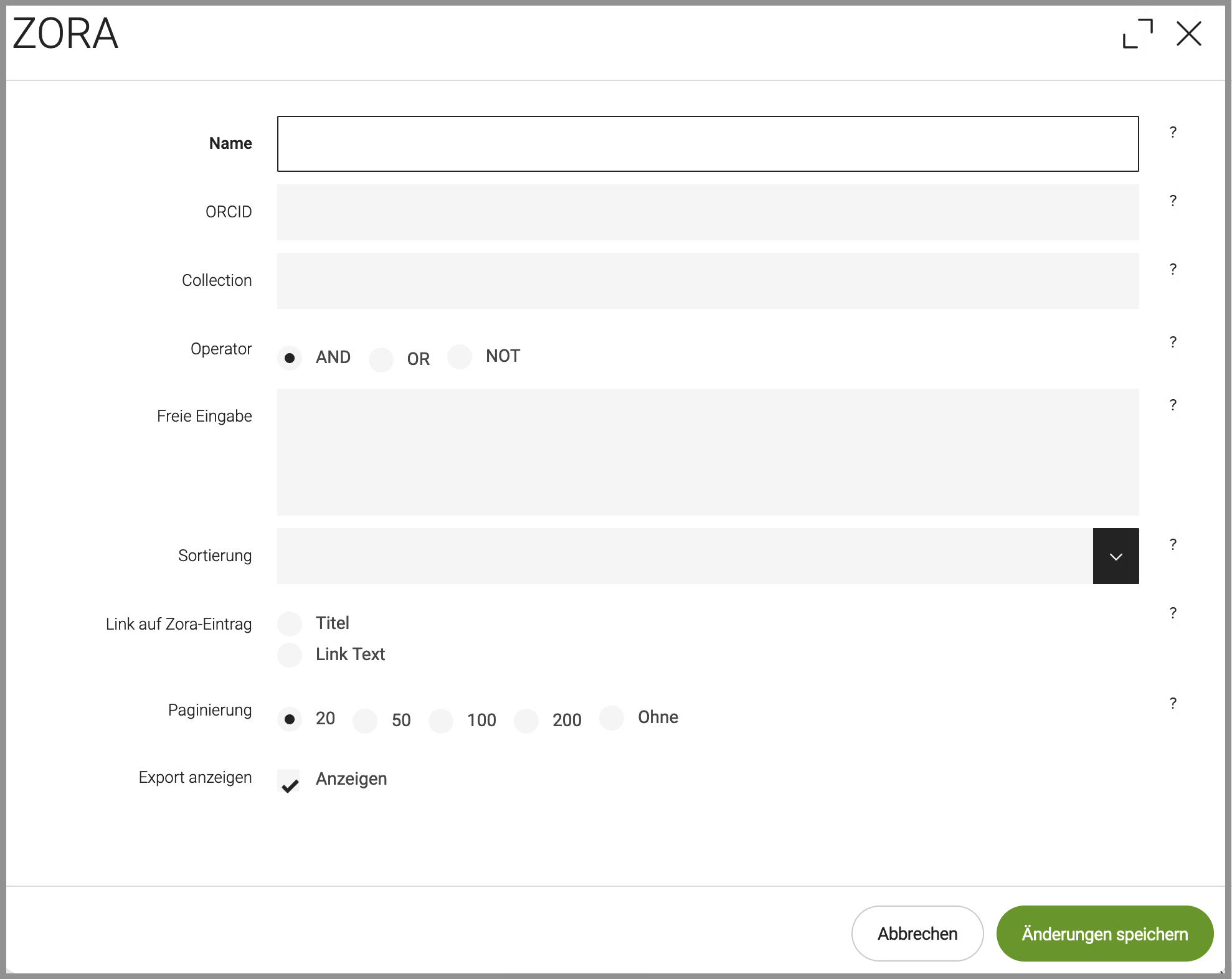
You can search for publications by the name or the ORCID (see box below) of an author. (Entering both fields at the same time does not make sense.) For "Name", enter the name exactly as it is given in ZORA (as a rule, this is "Surname, Initial". Ex: Einstein, A). You will find the list of authors in ZORA under Creators/Editors.
Alternatively, you can display all publications in a ZORA collection (see box below). These two search options can also be combined. In this case, the result sets are AND-linked: The search setting "Name: Gapp ” alone result to eleven hits, but in combination with the "Collection" 10242 only nine.
In the Collection field, you can still use the old (5-digit) Collection ID as well as the new UUID of the collection.
The selected operator determines the type of linkage of the subsequent "Free input" field with the search result defined by the preceding fields.
Free entry (Freie Eingabe)
The “Free entry” is combined with the entries in the first three fields. (However, only one of these fields may be filled in!) Select the appropriate combination operator. (If “OR” is selected, the first three fields may also be left blank).
The ZORA fields must be addressed in the specific notation described below. Please note the changes that have resulted from the migration from ZORA to DSpace on Sept. 25:
- (Author) AU=Grapp,Frederik (no space between surname and first name!)
- (Collection) As of September 2025, the Collection ID is now 36 characters long.
- Example: CC=accd1827-bb22-4ddd-a46a-9dbd19f402e4
- Previously, the ID was 5 characters long. It still works because it references the new ID in Zora.
- Example of old Collection ID: CC=10039
(Eprint-Id) EPID=138132- NEW: (DSpace-Id) DPID=87f0d1da-f545-4e00-ba2f-ea356165295a
- (Publisher/Editor) ED=Horn,Anita (no space between surname and first name!)
- (Type) TY=article (other types: book_section, conference_item, monograph, dissertation, habilitation, newspaper_article, edited_scientific_work, working_paper, published_research_report, scientific_publication_in_electronic_form)
- (Subtype) STY=original (or else: STY=further)
- (Publication Year) PY=2016 (Format: YYYY, -YYYY (to), YYYY- (from) or YYYY-YYYY)
- (Chair/Subject) CS=sSinologie0 (or: CS=cBehr0)
- Keyword) KW=infection
Several entries are possible. Each of them must be in a separate line. Entries for the same attribute contribute cumulatively to the result. Entries for different attributes are AND-linked (this is made clear in the Complex scenarios).
The DSpace ID is the UUID of a publication. You can find it in the URL of the individual entry when you call up this publication in ZORA (compare it with the DSpace ID above):
https://www.zora.uzh.ch/entities/publication/87f0d1da-f545-4e00-ba2f-ea356165295a
The remaining settings concern the display of the hit list. They are largely self-explanatory. Sorting also provides a more attractive display (PNG, 130 KB) of the search result. "Link Text" moves the link to the end of the citations. (By default, the publication titles link to the ZORA entry).
Usage and examples
Simple publication list
ZORA Publication List
Download Options
Publications
-
Funny boys, reluctant girls? The interaction between gender stereotypes and humour in children The Journal of Early Adolescence, 0, Epub ahead of print. https://doi.org/10.1177/02724316261457863
-
Linking Adolescents’ monitoring and regulation processes to learning and social classroom networks Contemporary Educational Psychology, 85, 102462. https://doi.org/10.1016/j.cedpsych.2026.102462
-
On the impact of exposure to different languages on Theory of Mind in neurotypical and autistic children Bilingualism: Language and Cognition, 29, 670–685. https://doi.org/10.1017/s136672892510031x
-
Entwicklungspsychologische Grundlagen In R. Markowetz, T. Hennemann, D. C. Hövel, & G. Casale (Eds.), Handbuch Förderschwerpunkt emotional-soziale Entwicklung (pp. 75–83). Beltz Juventa.
-
Diversity in monolingual and multilingual communicative environments and its relation to vocabulary in early childhood Bilingualism: Language and Cognition, 1–16. https://doi.org/10.1017/s1366728925100758
-
The Relation Between Goal‐Predictive Gaze Behavior and Imitation—A Live Eye‐Tracking Study in 12‐Month‐Olds Infancy, 30, e70050. https://doi.org/10.1111/infa.70050
-
The impact of balance of multilingual exposure on gesture comprehension in children above preschool age Applied Psycholinguistics, 46, e32. https://doi.org/10.1017/s0142716425100192
-
The two functions of imitation in the second year of life: A longitudinal study Developmental Psychology, 61, 1653–1668. https://doi.org/10.1037/dev0001856
-
Input to the Language Learning Infant: The Impact of Other Children Developmental Science, 28, e70045. https://doi.org/10.1111/desc.70045
-
Can you spot the funny face? An EEG study on slapstick humour processing in children Brain & Cognition, 188, 106334. https://doi.org/10.1016/j.bandc.2025.106334
-
Early Expressive and Receptive Language Development in Preterm vs Full-Term Children: A Meta-Analysis Pediatrics, 156, e2024070477. https://doi.org/10.1542/peds.2024-070477
-
How was your child’s temperament today and last week? Considering within-person variability in the measurement of infant temperament European Journal of Personality, 39, 575–590. https://doi.org/10.1177/08902070241289155
-
Influences on Data Quality in Developmental Children Studies Infant and Child Development, 34, e70035. https://doi.org/10.1002/icd.70035
-
Children Learn Causatives Despite Pervasive Ellipsis: Evidence from Turkish Journal of Child Language, 1–22. https://doi.org/10.1017/S0305000925000200
-
Children Find Others’ Misfortune Funnier Than Adults Social Development, 34, e12805. https://doi.org/10.1111/sode.12805
-
Avoiding unintentional injuries from household chemicals: Comparing the appeal to children from the perspectives of children, caregivers, and experts Applied Ergonomics, 122, 104401. https://doi.org/10.1016/j.apergo.2024.104401
-
Do Facial Masks Impact Infants’ Joint Attention? A Within‐Participant Laboratory Study. Infancy, 30, e12640. https://doi.org/10.1111/infa.12640
-
Infants’ Social Evaluation of Helpers and Hinderers: A Large‐Scale, Multi‐Lab, Coordinated Replication Study Developmental Science, 28, 1–28. https://doi.org/10.1111/desc.13581
-
Humans and great apes visually track event roles in similar ways PLoS Biology, 22, e3002857. https://doi.org/10.1371/journal.pbio.3002857
-
Measuring Theory of Mind: a preliminary analysis of a novel linguistically simple and tablet-based measure for children Frontiers in Developmental Psychology, 2, 1445406. https://doi.org/10.3389/fdpys.2024.1445406