ZORA
Table of contents
Description
The component "ZORA" allows the inclusion of publications listed in the Zurich Open Repository and Archive (ZORA). These lists are generated dynamically, i.e. they reflect the current content of ZORA.
Creation
- Click on "New Content Component" in the "Content" area.
- Select "ZORA" and confirm with "Next".
The following window is displayed:
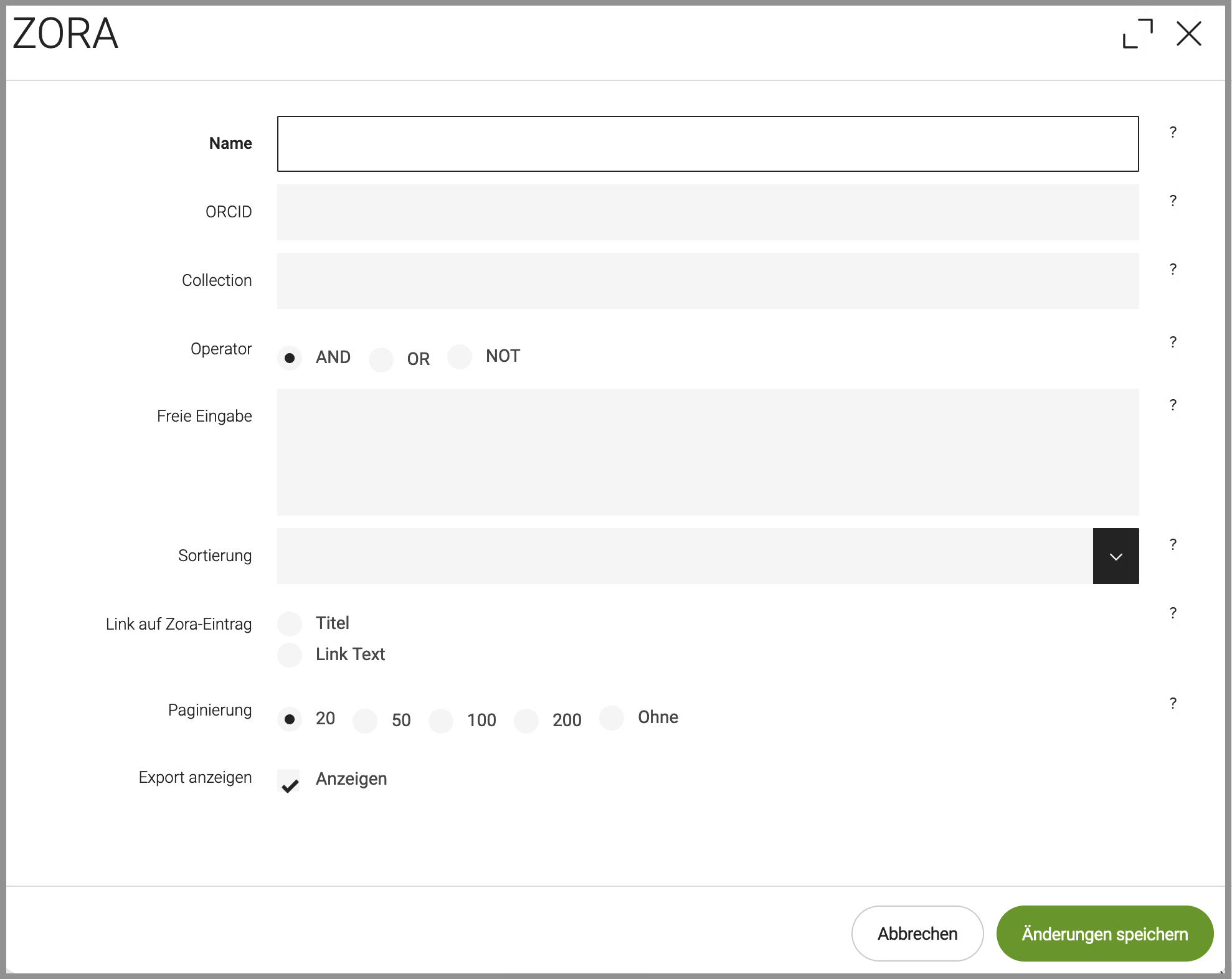
You can search for publications by the name or the ORCID (see box below) of an author. (Entering both fields at the same time does not make sense.) For "Name", enter the name exactly as it is given in ZORA (as a rule, this is "Surname, Initial". Ex: Einstein, A). You will find the list of authors in ZORA under Creators/Editors.
Alternatively, you can display all publications in a ZORA collection (see box below). These two search options can also be combined. In this case, the result sets are AND-linked: The search setting "Name: Gapp ” alone result to eleven hits, but in combination with the "Collection" 10242 only nine.
In the Collection field, you can still use the old (5-digit) Collection ID as well as the new UUID of the collection.
The selected operator determines the type of linkage of the subsequent "Free input" field with the search result defined by the preceding fields.
Free entry (Freie Eingabe)
The “Free entry” is combined with the entries in the first three fields. (However, only one of these fields may be filled in!) Select the appropriate combination operator. (If “OR” is selected, the first three fields may also be left blank).
The ZORA fields must be addressed in the specific notation described below. Please note the changes that have resulted from the migration from ZORA to DSpace on Sept. 25:
- (Author) AU=Grapp,Frederik (no space between surname and first name!)
- (Collection) As of September 2025, the Collection ID is now 36 characters long.
- Example: CC=accd1827-bb22-4ddd-a46a-9dbd19f402e4
- Previously, the ID was 5 characters long. It still works because it references the new ID in Zora.
- Example of old Collection ID: CC=10039
(Eprint-Id) EPID=138132- NEW: (DSpace-Id) DPID=87f0d1da-f545-4e00-ba2f-ea356165295a
- (Publisher/Editor) ED=Horn,Anita (no space between surname and first name!)
- (Type) TY=article (other types: book_section, conference_item, monograph, dissertation, habilitation, newspaper_article, edited_scientific_work, working_paper, published_research_report, scientific_publication_in_electronic_form)
- (Subtype) STY=original (or else: STY=further)
- (Publication Year) PY=2016 (Format: YYYY, -YYYY (to), YYYY- (from) or YYYY-YYYY)
- (Chair/Subject) CS=sSinologie0 (or: CS=cBehr0)
- Keyword) KW=infection
Several entries are possible. Each of them must be in a separate line. Entries for the same attribute contribute cumulatively to the result. Entries for different attributes are AND-linked (this is made clear in the Complex scenarios).
The DSpace ID is the UUID of a publication. You can find it in the URL of the individual entry when you call up this publication in ZORA (compare it with the DSpace ID above):
https://www.zora.uzh.ch/entities/publication/87f0d1da-f545-4e00-ba2f-ea356165295a
The remaining settings concern the display of the hit list. They are largely self-explanatory. Sorting also provides a more attractive display (PNG, 130 KB) of the search result. "Link Text" moves the link to the end of the citations. (By default, the publication titles link to the ZORA entry).
Usage and examples
Simple publication list
ZORA Publication List
Download Options
Publications
-
Adults Adapt to Child Speech in Causative Semantics Cognitive Science, 48, e13495. https://doi.org/10.1111/cogs.13495
-
Keeping up with ourselves: Multimodal processes underlying body ownership across the lifespan Cortex, 177, 209–223. https://doi.org/10.1016/j.cortex.2024.05.013
-
Speaker Competence Affects Prefrontal Theta and Occipital Alpha Power during Selective Word Learning in Preschoolers Journal of Cognitive Neuroscience, 36, 1523–1540. https://doi.org/10.1162/jocn_a_02162
-
Children’s recognition of slapstick humor is linked to their Theory of Mind. Frontiers in Cognition, 3, 1–10. https://doi.org/10.3389/fcogn.2024.1369638
-
Responsible Research is also concerned with generalizability: Recognizing efforts to reflect upon and increase generalizability in hiring and promotion decisions in psychology Meta-Psychology, 8, 1–6. https://doi.org/10.15626/mp.2023.3695
-
The proximate regulation of prosocial behaviour: towards a conceptual framework for comparative research Animal Cognition, 27, 5. https://doi.org/10.1007/s10071-024-01846-w
-
What’s the point? Infants’ and adults’ perception of different pointing gestures. Infancy, 29, 251–270. https://doi.org/10.1111/infa.12579
-
From everyday exposure to pragmatic mastery International Review of Pragmatics, 16, 149–161. https://doi.org/10.1163/18773109-01601006
-
Automatic imitation in school-aged children Journal of Experimental Child Psychology, 238, 105797. https://doi.org/10.1016/j.jecp.2023.105797
-
Mini-review: Wild laughs: Ontogenesis and phylogenesis of humour Neuroscience Letters, 822, 137615. https://doi.org/10.1016/j.neulet.2023.137615
-
Cardiac interoception in infants: Behavioral and neurophysiological measures in various emotional and self‐related contexts Psychophysiology, 60, e14386. https://doi.org/10.1111/psyp.14386
-
What do you focus on? An investigation of goal focus from childhood to old age Psychological Research, 87, 2120–2137. https://doi.org/10.1007/s00426-023-01804-0
-
Atypical gaze-following behaviour in infants with congenital heart disease Early Human Development, 181, 105765. https://doi.org/10.1016/j.earlhumdev.2023.105765
-
Chasing the “How” and “Why” of goal pursuit: A multimethod approach to the study of goal focus Journal of Research in Personality, 104, 104371. https://doi.org/10.1016/j.jrp.2023.104371
-
The Agent Preference in Visual Event Apprehension Open Mind, 1–43. https://doi.org/10.1162/opmi_a_00083
-
Gradual Route to Productivity: Evidence from Turkish Morphological Causatives Cognitive Science, 46, 13210. https://doi.org/10.1111/cogs.13210
-
Seeing household chemicals through the eyes of children—Investigating influential factors of preschoolers’ perception and behavior Journal of Safety Research, 83, 400–409. https://doi.org/10.1016/j.jsr.2022.09.015
-
Prior Action Direction of a Novel Agent Cues Spatial Attention in 7-Month-Old Infants Swiss Journal of Psychology, 2, 1–15. https://doi.org/10.5334/spo.38