ZORA
Table of contents
Description
The component "ZORA" allows the inclusion of publications listed in the Zurich Open Repository and Archive (ZORA). These lists are generated dynamically, i.e. they reflect the current content of ZORA.
Creation
- Click on "New Content Component" in the "Content" area.
- Select "ZORA" and confirm with "Next".
The following window is displayed:
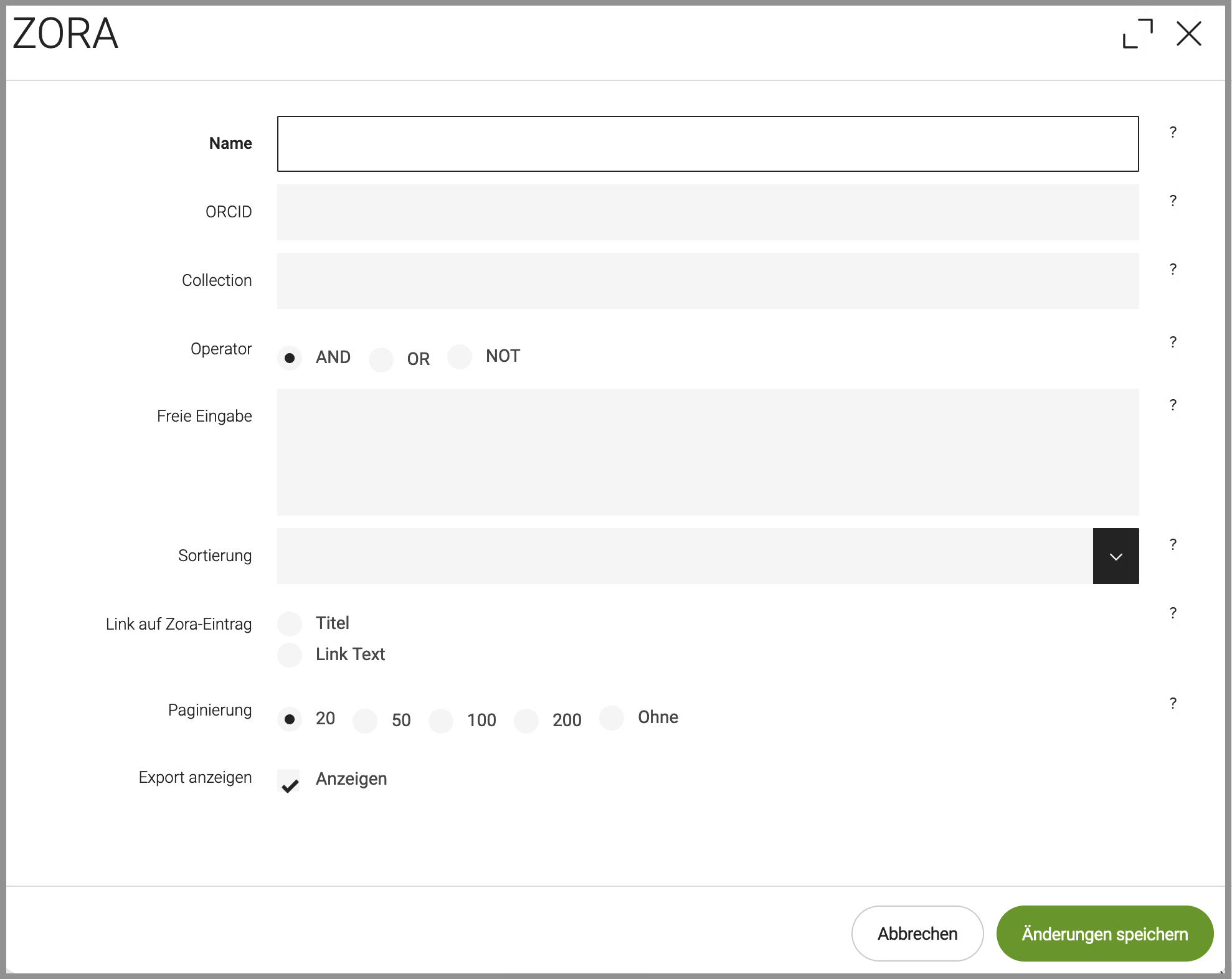
You can search for publications by the name or the ORCID (see box below) of an author. (Entering both fields at the same time does not make sense.) For "Name", enter the name exactly as it is given in ZORA (as a rule, this is "Surname, Initial". Ex: Einstein, A). You will find the list of authors in ZORA under Creators/Editors.
Alternatively, you can display all publications in a ZORA collection (see box below). These two search options can also be combined. In this case, the result sets are AND-linked: The search setting "Name: Gapp ” alone result to eleven hits, but in combination with the "Collection" 10242 only nine.
In the Collection field, you can still use the old (5-digit) Collection ID as well as the new UUID of the collection.
The selected operator determines the type of linkage of the subsequent "Free input" field with the search result defined by the preceding fields.
Free entry (Freie Eingabe)
The “Free entry” is combined with the entries in the first three fields. (However, only one of these fields may be filled in!) Select the appropriate combination operator. (If “OR” is selected, the first three fields may also be left blank).
The ZORA fields must be addressed in the specific notation described below. Please note the changes that have resulted from the migration from ZORA to DSpace on Sept. 25:
- (Author) AU=Grapp,Frederik (no space between surname and first name!)
- (Collection) As of September 2025, the Collection ID is now 36 characters long.
- Example: CC=accd1827-bb22-4ddd-a46a-9dbd19f402e4
- Previously, the ID was 5 characters long. It still works because it references the new ID in Zora.
- Example of old Collection ID: CC=10039
(Eprint-Id) EPID=138132- NEW: (DSpace-Id) DPID=87f0d1da-f545-4e00-ba2f-ea356165295a
- (Publisher/Editor) ED=Horn,Anita (no space between surname and first name!)
- (Type) TY=article (other types: book_section, conference_item, monograph, dissertation, habilitation, newspaper_article, edited_scientific_work, working_paper, published_research_report, scientific_publication_in_electronic_form)
- (Subtype) STY=original (or else: STY=further)
- (Publication Year) PY=2016 (Format: YYYY, -YYYY (to), YYYY- (from) or YYYY-YYYY)
- (Chair/Subject) CS=sSinologie0 (or: CS=cBehr0)
- Keyword) KW=infection
Several entries are possible. Each of them must be in a separate line. Entries for the same attribute contribute cumulatively to the result. Entries for different attributes are AND-linked (this is made clear in the Complex scenarios).
The DSpace ID is the UUID of a publication. You can find it in the URL of the individual entry when you call up this publication in ZORA (compare it with the DSpace ID above):
https://www.zora.uzh.ch/entities/publication/87f0d1da-f545-4e00-ba2f-ea356165295a
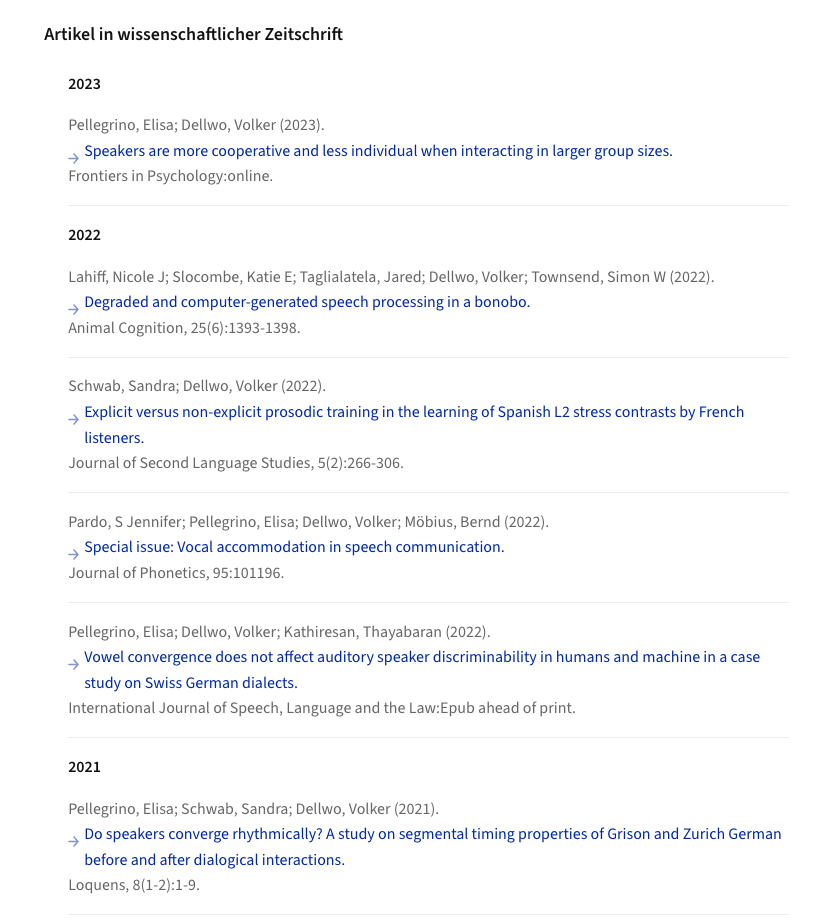
The remaining settings concern the display of the hit list. They are largely self-explanatory. Sorting also provides a more attractive display (PNG, 130 KB) of the search result. "Link Text" moves the link to the end of the citations. (By default, the publication titles link to the ZORA entry).
Usage and examples
Simple publication list
ZORA Publication List
Download Options
Publications
-
Household chemicals and pre-schoolers: Caretakers’ beliefs and perspectives on risks and responsibilities Safety Science, 154, 105864. https://doi.org/10.1016/j.ssci.2022.105864
-
The kleineWeltentdecker App - A smartphone-based developmental diary Behavior Research Methods, 54, 2522–2544. https://doi.org/10.3758/s13428-021-01755-7
-
Exploring the role of COVID-19 pandemic-related changes in social interactions on preschoolers’ emotion labeling. Frontiers in Psychology, 13, 942535. https://doi.org/10.3389/fpsyg.2022.942535
-
Infancy researchers need to change the way they develop their measures: A comment on Byers‐Heinlein et al. (2021) Infant and Child Development, 31, e2322. https://doi.org/10.1002/icd.2322
-
Spelling out some unaddressed conceptual and methodological challenges in empirical lifespan research Acta Psychologica, 226, 103585. https://doi.org/10.1016/j.actpsy.2022.103585
-
Do typological differences in the expression of causality influence preschool children’s causal event construal? Language and Cognition, 14, 161–184. https://doi.org/10.1017/langcog.2021.26
-
Mothers Reveal More of Their Vocal Identity When Talking to Infants (No. 4088888; SSRN). https://doi.org/10.2139/ssrn.4088888
-
For Whom Is the Path the Goal? A Lifespan Perspective on the Development of Goal Focus Collabra: Psychology, 8, 31603. https://doi.org/10.1525/collabra.31603
-
To Merge or Not? Phylogenetic and Ontogenetic Insights on Self‐Other Integration and Distinction During Joint Action (Dissertation, University of Zurich) https://doi.org/10.5167/uzh-227540
-
Children’s group loyalty is related to parental in-group collectivism Cognitive Development, 61, 101130. https://doi.org/10.1016/j.cogdev.2021.101130
-
Predicting Reading From Behavioral and Neural Measures – A Longitudinal Event-Related Potential Study Frontiers in Psychology, 12, 733494. https://doi.org/10.3389/fpsyg.2021.733494
-
When dogs meow: An electrophysiological study of lexical-semantic processing in toddlers Infancy, 26, 1076–1096. https://doi.org/10.1111/infa.12434
-
Development of the bodily self: Effects of visuomotor synchrony and visual appearance on virtual embodiment in children and adults Journal of Experimental Child Psychology, 210, 105200. https://doi.org/10.1016/j.jecp.2021.105200
-
Influence of causal language on causal understanding: A comparison between Swiss German and Turkish Journal of Experimental Child Psychology, 210, 105182. https://doi.org/10.1016/j.jecp.2021.105182
-
Child-directed speech is optimized for syntax-free semantic inference Scientific Reports, 11, 16527. https://doi.org/10.1038/s41598-021-95392-x
-
Does Linguistic Similarity Affect Early Simultaneous Bilingual Language Acquisition? Journal of Language Contact, 13, 482–500. https://doi.org/10.1163/19552629-13030001
-
Parenting Styles of Gay Fathers Journal of GLBT Family Studies, 17, 102–117. https://doi.org/10.1080/1550428x.2020.1806769
-
Compatibility Effects in Young Children’s Tool Use: Learning and Transfer. Child Development, 92, e76–e90. https://doi.org/10.1111/cdev.13455
-
Processes Underlying Social Learning – The Influence of Informant Characteristics on Children’s Attention and Memory Processes in Action and Word Learning (Dissertation, University of Zurich) https://doi.org/10.5167/uzh-208948